
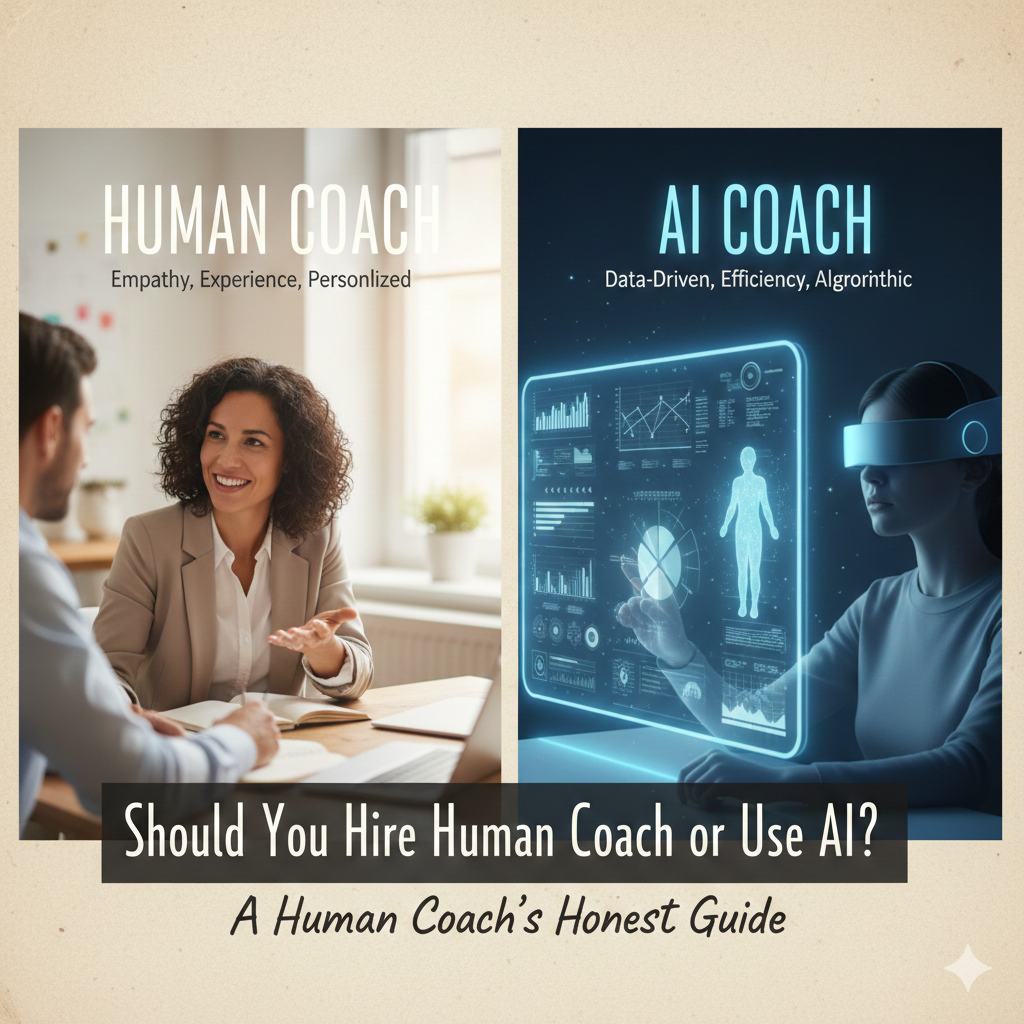
I just spent an hour being coached by an AI.
As an executive coach who’s built my practice on the Socratic method, this felt uncomfortably close to home. The AI asked insightful questions. It challenged my assumptions. It helped me see my problem from broader perspectives. I had genuine “aha moments.”
I felt coached.
And I’m not going to lie: it made me uncomfortable. Because if an AI can do what I do, what exactly are my clients paying for?
This article started as a defensive reaction—a way to explain why human coaching is still relevant. But through that AI coaching conversation, I discovered something more honest: The question isn’t whether AI can coach. It clearly can. The real question is what you’re actually seeking when you hire a coach—and whether that requires a human.
What AI Coaching Does Remarkably Well
Let me be clear: AI coaching is genuinely impressive. During my session, the AI did everything a good coach should do—listened, asked probing questions, reframed problems, and opened new possibilities.
And it was endlessly patient. Available at 2 AM. No relationship to manage, no concern about being judged. For $20 a month, you get unlimited access to a remarkably sophisticated thinking partner.
For someone who processes thoughts by talking them through, has strong self-accountability, and needs a thinking partner more than a relationship—AI coaching might be the better choice.
So why would anyone pay significantly more for a human coach? Honestly, as I sat with that question, part of me wished I had a more reassuring answer—for myself as much as for my clients.
What Happened When the Session Ended
The AI conversation was excellent. And then it was… over.
No follow-up. No next session where someone would notice if I’d done anything with those insights. No relationship that carried forward.
With my human clients, the coaching happens between our sessions too—when they know they’ll see me again, when they catch themselves avoiding something and think, “Ananthan is going to ask me about this.”
But here’s what’s more subtle: my most transformational client relationships often started with skepticism. They came uncertain, guarded. And gradually—sometimes over months—they began sharing more. The breakthroughs came not from brilliant questions, but from a growing sense of safety in the relationship itself.
Those clients weren’t just looking for insights. They were looking for someone to witness their struggle, validate their approach when they doubted themselves, and genuinely care whether they succeeded.
When a skeptical client finally opens up to me, it’s because over time, they came to trust that I’m invested in their success.
Can an AI be invested? Can it care?
Who Needs a Human Coach
Not everyone needs what human coaching uniquely provides. And that’s okay.
But some people need the human element as the actual mechanism of change:
Those who struggle with self-accountability. If you make commitments to yourself and quietly let them slide, an AI won’t notice. I will—not with judgment, but with genuine curiosity about what happened.
Those working through complex emotional dynamics. When a client says “I’m fine” but their energy has completely shifted, I notice. I read what’s not being said. I sense when to push and when to back off.
Those who need the relationship itself as the container for change. Some breakthroughs come from experiencing a different kind of relationship—someone consistently present, genuinely curious, holding space for both your brilliance and your struggles.
Yes, AI remembers past conversations and can ask about your progress. But here’s something I’ve noticed that I can’t fully explain: when I ask a client about something they were worried about, there’s a difference. The AI is retrieving information. I’m genuinely wondering because I’ve been carrying their story with me.
Some of my clients have told me that knowing someone is genuinely tracking their journey—not just storing data about it, but caring about the outcome—changes how they show up.
How to Decide
Here’s my honest advice: try AI coaching first. Have a few sessions. Notice what works and what’s missing.
If you find yourself wishing someone was tracking your journey over time, or you’re not implementing despite good insights, or you need someone who can read what you’re not saying—then consider human coaching.
And if AI coaching gives you exactly what you need? That’s perfectly fine. The goal is your growth, not protecting my profession.
What I’m Still Figuring Out
I started this article worried about whether human coaching could survive in an age of AI. I’m ending it with different questions.
Maybe AI isn’t replacing coaches. Maybe it’s forcing coaches like me to get clearer about what we actually offer—and to stop hiding behind techniques that can be replicated.
For years, I’ve described my work through methods: the Socratic approach, the powerful questions, the frameworks. All of that can be learned by AI.
What can’t be replicated is the experience of being genuinely seen by another person. Of having someone carry your story with them between sessions. Of knowing that your growth matters to someone else, not as data, but as a human reality they’re invested in.
Is that worth the premium of human coaching? For some people, absolutely. For others, honestly, maybe not.
AI hasn’t made human coaching obsolete. But it has made lazy coaching obsolete – coaching that relies only on technique rather than genuine human presence.
And maybe that’s exactly what our profession needed.
PS: Article conceived and edited by me, drafted with the help of an AI tool.
